
The Day the Cart Path Became a Water Hazard
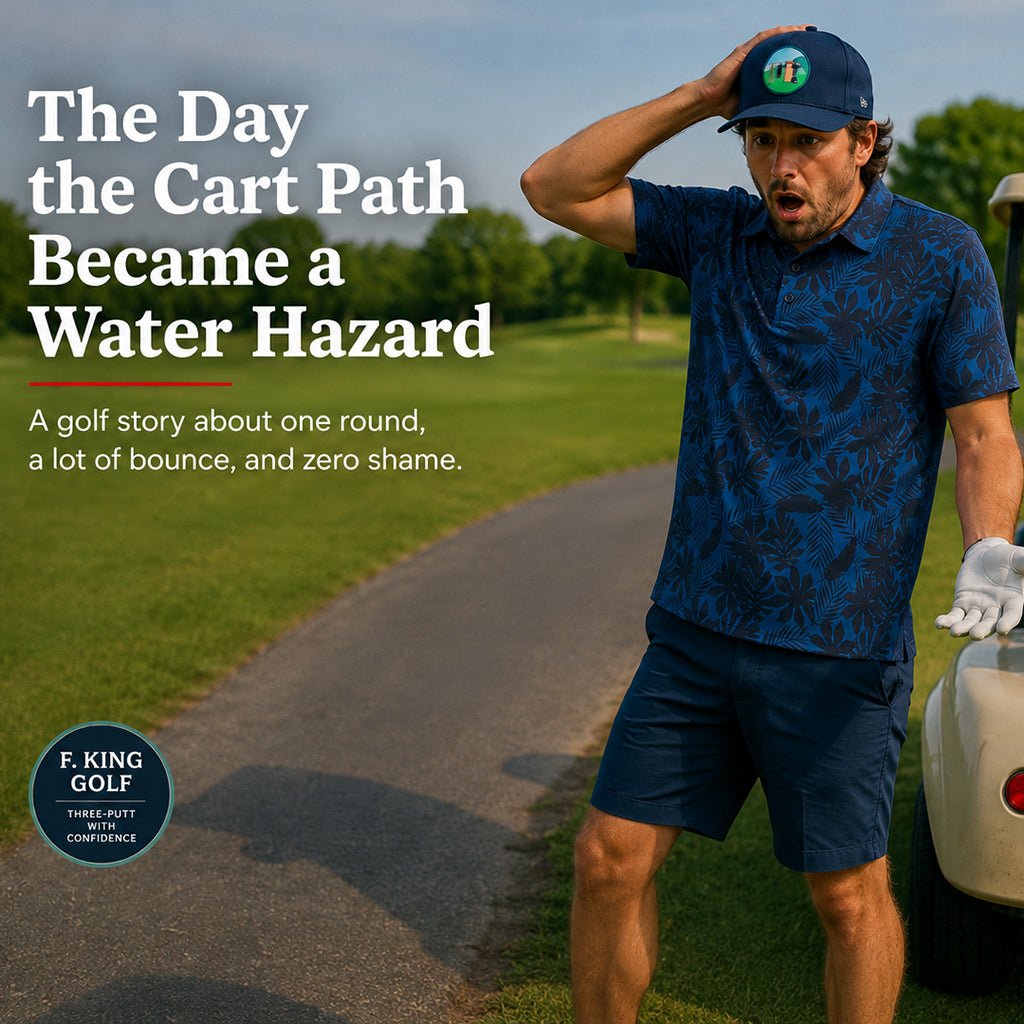

Every golf group has that one player who says, “I’m due.”
This is never a good sign.
Nobody who is actually playing well says they are due. You only say “I’m due” after six bad holes, three lost balls, and one emotional support hot dog from the turn. It is not a statement of confidence. It is a cry for help dressed up as optimism.
On this particular Saturday, that player was Mike.
Mike had spent the front nine playing what can only be described as “exploratory golf.” He visited parts of the course that were not included on the scorecard. He found a maintenance shed. He hit out of mulch. At one point, his ball came to rest near a sprinkler head, a pine cone, and what appeared to be a raccoon footprint.
Still, standing on the 10th tee, Mike looked down the fairway and said it.
“I’m due.”
The rest of us immediately stepped back.
The 10th hole was not especially difficult. A short par 4, slight dogleg right, wide enough fairway, and a cart path running along the left side. Simple. Safe. Friendly.
Mike pulled driver.
This was the first warning.
His practice swing looked good. His setup looked confident. For one brief, beautiful second, we all believed.
Then he swung.
The sound was not the clean crack of a driver meeting the center of the face. It was more of a metallic cough. The ball launched low and hard left, like it had somewhere urgent to be. It hit the cart path once, skipped higher than physics should allow, hit the path again, and began traveling down the pavement with the determination of a commuter late for work.
We watched in silence.
The ball bounced past the forward tees.
Then past the 150 marker.
Then past a group on the next hole, who all turned around like they had just heard a car backfire.
Finally, the ball disappeared over a small hill near the green.
Mike held his follow-through for way too long.
“Should be fine,” he said.
Nobody responded.
We got in the carts and started the search. After about two minutes, we found his ball resting just off the green. Not on the 10th green, of course. The 14th green.
For a moment, Mike looked proud.
“I mean, distance-wise…”
No.
Absolutely not.
There are many ways to get near a green in golf. A well-struck drive. A smart layup. A crisp approach shot. Ricocheting off 300 yards of concrete and accidentally joining another hole is not one of them.
The group on 14 was less impressed.
One guy stood there holding his putter, staring at Mike’s ball like it had personally insulted his family. Another pointed back toward our tee box with the kind of slow, disappointed motion usually reserved for airport runway workers.
Mike waved.
Not an apology wave. More of a “great weather today” wave.
We convinced him to pick up the ball and return to our hole before things got weird. Which, in fairness, they already had.
Back on 10, Mike dropped a ball in the rough near where we guessed his drive should have ended if it had behaved like a normal object. He grabbed a wedge, took one practice swing, and said, “Now I just need to settle down.”
This was the second warning.
His next shot was supposed to be a simple pitch back into the fairway. Instead, he caught it thin, sending the ball screaming across the grass and directly into the tire of our golf cart.
It hit the tire, bounced straight up, landed in the cup holder, and knocked over a half-full sports drink.
Nobody moved.
There are golf shots you remember because they are great. Hole-outs. Long putts. Pure irons into the wind.
Then there are golf shots you remember because they make everyone question whether the game is real.
Mike walked over, looked at the ball sitting in a puddle of blue sports drink, and said, “That’s unplayable, right?”
At this point, Dave lost it.
Dave is the calm one in the group. The guy who says things like “good tempo” and “take your medicine.” But watching a golf ball go from tee box to cart path to another hole to cup holder was too much. He bent over laughing so hard he had to use his putter as a cane.
By the time we reached the green, nobody knew what Mike was lying. Four? Seven? Emotionally, twelve.
Mike had a twenty-foot putt for what he called “a gentleman’s double.” The rest of us did not ask questions.
He lined it up carefully. Took two practice strokes. Looked at the hole.
“This would be huge,” he said.
It was not huge.
He left it eight feet short.
Naturally, he looked at all of us and asked, “Good good?”
The silence was immediate.
Now, there are moments in every friendship where the group must decide who they really are. Are they generous? Supportive? Forgiving?
Or are they golfers?
Dave shook his head.
“Putt it.”
Mike stared at him like he had just been betrayed in a movie.
He missed.
The comeback putt lipped out too.
By the time the ball finally dropped, Mike picked it out of the cup and said, “Put me down for bogey.”
That is when we learned something important.
Golf scorekeeping is not math. It is storytelling.
And Mike was writing fiction.
The rest of the round continued exactly how you would expect. Mike hit one incredible 7-iron on 13 and immediately announced he had “figured something out.” He had not. On 16, he topped a hybrid so badly it rolled between the tee markers and stopped behind him. On 18, he hit the best drive of the day, then chunked a wedge into a pond that was not really in play.
Afterward, we sat on the patio, eating fries and pretending to remember our scores.
Mike raised his drink and said, “Honestly, I played better than I scored.”
This time, nobody argued.
Because in a way, he was right.
He gave us a story. He gave us laughter. He gave the group on 14 something to talk about for the rest of their lives. And most importantly, he reminded us that golf is not always about fairways, greens, and clean pars.
Sometimes it is about a ball taking the cart path expressway into another zip code.
Sometimes it is about calling “good good” from eight feet after committing several crimes against the scorecard.
Sometimes it is about showing up, swinging hard, laughing harder, and accepting that the game makes fools of us all.
Mike did not break 90 that day.
He may not have broken 110.
But he did become a legend.
And honestly, that is better than par.